Home Blog Page 10

Is an African Safari Really Expensive?

0
Luxury African Safari

Africa is a beautiful continent that once you have visited you will find yourself coming back because you have not explored all the beauty. While planning An African safari, the overall questions would be what is my budget? What kind of experience do I want to have while on a safari otherwise in general an African safari can be cheap or expensive depending on what you want and how to get around, and accommodation. The choice you make will determine the cost of African safari but the experience of meeting wild life mountain Gorillas in in nature, herds and a big population of wild life on a game drive safari in the savannah is unforgettable.

Below we highlight a few factors to determine the cost of your African safari.

Solo Traveler

Traveling solo may save unnecessary expenses and save you spending a fortune. Going solo means you can manage a self-drive or take public means of transport to connect to your destination, you therefore need no experienced guide and can do it by yourself. It’s also easy to get cheap accommodation and can also opt for camping when you carry your camping necessities. The only disadvantaged is that you may miss out on important because of lack of experience to spot them.

Season

This plays a great role in determining the cost of an African safari. Most African countries have good weather, humid, hot and moderate. Dry season attract more travellers and you will find all accommodation facilities fully booked, safari activities like Gorilla tracking in Uganda and Rwanda have no availability. Whereas during the rainy season is associated with low season and few travelers. While planning an African safari to cut cost seasonality need to be considered.

Transportation

In most African countries there is poor connection of roads that require a 4WD car, however you will also find small charter planes to connect you these remote areas. The choice to fly or drive will determine the cost of your African safari.

Accommodation

Accommodation is in three categories, budget, mid range and luxury. This does not necessarily mean the services are poor but the level of comfort ability differs. The choice you make determines the cost of your African safari.

Tips to Help You Travel for Less

Travel as group

This can be family, friends or work mates, travelling as group help to split and share costs especially transport and accommodation. You can opt to rent hire a van and also share an apartment all group members. This will definitely give a fun filled safari.

Short holiday safaris

Have short safaris but with a memorable experience for example you can do  a 4day safari with major activities like gorilla trekking and a game drive to sport the big five ,predators and other wildlife. Short holidays call for less spending and longer days cost an African safari a fortune.

Best 10 National Parks in East Africa

0
Serengeti Wilderness

The East African region contains 5 countries which include Uganda, Rwanda, Kenya and Tanzania. These countries together hold diverse wildlife, beautiful landscapes and culture. The wildlife can be enjoyed in national parks of different countries in a number of ways such as such as going on a safari, primate trekking adventures, hiking. The best way to that is to obtain the East African Single Tourist visa which grants you free entry and exit into Uganda, Rwanda and Kenya. Unfortunately Tanzania hasn’t joined, so you will have to purchase a separate Tanzania tourist visa.

With so many things to do and see, it can be difficult to decide the parks to visit. This list can help you choose the wildlife and attractions you want to see on a safari.

Bwindi Impenetrable National Park (South Western Uganda)

One of the biologically diverse places, this UNESCO world heritage site Bwindi impenetrable National Park is where half of the world’s mountain gorilla population lives. The most sought after wildlife encounter on earth is likely to be seeing mountain gorillas in their natural habitat. The main visitor activity is gorilla trekking which provides opportunity to see some of the 17 habituated mountain gorillas in their natural habitat. The best time for a gorilla safari in the park is during the dry season from December to February and June to September. Planning to do gorilla trekking in this park, you have to book a gorilla permit and accommodation three months in advance due to get the best of your interest.

Bwindi is located in south western Uganda about 502 km from the capital Kampala. By road the journey takes 8-10 hours but includes stopovers such as equator crossing experiment, drum making experience plus friendly locals and scenery. However coming from Kigali Rwanda provide the quick access to Bwindi by 3 hours drive. Travelers can fly with Rwanda Air and then cross over to Uganda for gorilla trekking. In addition to gorilla trekking, tourists can take village walks in the local communities. There are Bakiga and Batwa pygmies offering cultural encounters. you get to learn about their traditions, food, dance performances and arts and crafts.

Serengeti National Park (Tanzania)

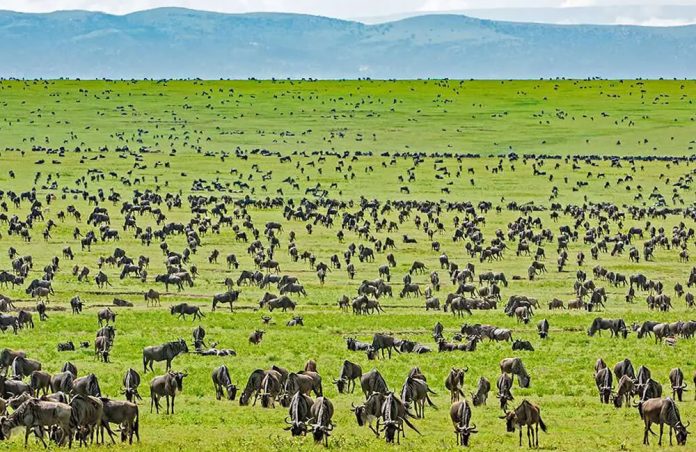
2 million wildebeests along with zebra, grant’s gazelles and other antelopes set off from Serengeti national park and thus this park provides the best chances to see the greatest wildlife spectacle on earth. The wildebeest migration is the most sought after experience as the animals move between Serengeti ecosystem and Masai Mara reserve in Kenya in search of green pastures and water. The best time to view wildebeest is during December to February and June to July.

That’s not all; in addition to the wildebeest migration, Serengeti is home to diverse wildlife including the big five African mammals. That is the elephants, buffalo, black rhino and the largest population of lions. Other animals include cheetah and about 500 species of birds including ostrich. Guided game drive safari offer the best chance to spot wildlife morning and evening. Black rhinos and are not frequently seen in this park but are largely found in the neighboring Ngorongoro crater.

Serengeti is very huge area covering an area of 14, 763 sq km. The beautiful savannah wilderness is dotted by granite rocks, yellow fever acacia, and lush palm trees and swampy areas around the Grumeti River and Serenore valley.

Tourists can get to the park from Arusha or Nairobi. Fly to Kilimanjaro airport and then again by charter plane to the park.  The road from Arusha is dirt and bumpy to Serengeti is 300 km taking 8 hours.

Masai Mara Reserve –Kenya

Explore the Land of the Masai People. The Masai-Mara wildlife reserve is one of the best places in Africa to see the big cats such as leopard, lion and cheetahs. It is found in the great east African rift valley floor contiguous with Serengeti national park. The great wildebeest migration also happens in this park during the month of July to September.

Masai Mara is Kenya’s true natural wonder incredibly diverse with hills and plateaus, rift valley escarpments, lush savannah grasslands and acacia woodlands. These habitats provide home to large mammals which include elephant, rhino, buffalo, zebra, giraffe and various antelope species. The wildlife is surrounded by the Masai cattle warriors. It wouldn’t be a complete wildlife safari without visiting the masi villages to learn their unique culture and grab souvenirs.

Nairobi National Park – Kenya

Located less than 40 minutes drive outside Nairobi Kenya’s capital city, Nairobi national park is 117 sq km park but home to endangered black rhinos. Successful conservation and protection of more than 50 black rhinos make this park one of the best in East Africa. Other animals include lions, cheetahs, hyenas, buffaloes, zebras, ostrich, giraffes, and gazelles. Such a small park with abundant wildlife including 400 species of birds, and less than 10 minutes drive from Nairobi, so you have no excuse whatsoever to get there. If you are into wildlife viewing for any short amount of time while in Nairobi, you can do half day safari for game viewing. Animals can be viewed against the backdrop of the city and perhaps you could get that postcard shot of a rhino, giraffe, lion, or zebra. Get on the way by public bus or safari vehicle from Monday to Sunday and secure entrance with rangers for amazing wildlife viewing.

Murchison Falls National park- Uganda

Uganda’s largest conservation area, Murchison Falls National park is located at the northern tip of the Albertine rift valley. The park is bisected by river Nile creating Murchison waterfalls, the world’s strongest waterfall which is a magnificent feature of this park. The Nile creates diverse habitats such as the Albert-Nile delta wetland, savannah, rain forests, and palm forests. It is one of the wildlife rich areas. More than 75 mammals are recorded in the park including African elephants, buffalo, lion, leopard, white rhino, giraffe, and Uganda kob.

The Nile divides the park into north and south. Game viewing is mostly done in the northern part towards the Albert-Nile delta wetland and so you will have to cross the river by ferry. In the south of the park, there are chimpanzees in Budongo Forest Reserve. This park stands out with opportunities for tourists to do game drives, river Nile boat cruises to see hippos and crocodiles, as well do chimpanzee trekking in the south Budongo forest.

It is a great birding destination too, more than 451 species of bird that include shoebill stork, African fish eagle, Abyssinian ground hornbill, goliath heron, African darter, white faced whistling duck, martial eagle among others.

You can visit this park by minimum 3 days if you are not doing a trip around western Uganda. The park is located 4 hours drive from Kampala. En route to the park, you have the chance to stop at Ziwa rhino sanctuary for guided rhino trekking on foot with rangers. The top of the falls view is breathtaking when you hike to cliff above the waterfalls.

Ngorongoro Conservation Area – Tanzania

This UNESCO world heritage site Ngorongoro crater is referred to as the cradle of mankind. Traces of first known human species to live on earth about 2 million years ago were discovered at Olduvai Gorge by Dr. Louis leaky. Ngorongoro crater is home to over 25,000 mammals. The rich wildlife and human history has put Ngorongoro on the list of African natural wonders.

It is known as the best place in Tanzania to spot the big five African mammals. A pride of more than 50 lions lives within the crater along with predators like hyena and leopard. The crater is not actually a lake but an intact caldera up to 12 miles wide and it’s where much of the wildlife. Good enough, some of the luxury lodges enable visitors to sleep in the caldera rim and wake up to sunrise and game viewing with the best chance to see black rhinos and the big five too. the wildebeest migration also passes through the crater though not in big numbers as in Serengeti or Masai Mara.

Volcanoes National Park – Rwanda

The Volcanoes National Park is home to mountain gorillas and these are the main attractions for any trip to Rwanda. Very easy to access by 2 hours drive from Kigali international airport, for travelers with limited time, volcanoes provide the best chance for gorilla trekking safari for a day or just 2. There are 10 habituated gorilla families which are found within the park. The price of a gorilla trekking permit was recently hiked to US$1500 per person. This was a quest to avoid overcrowding and that’s how Rwanda takes conservation very serious. Gorilla numbers in Virunga massif have increased to 604 with new census results, and partly volcanoes is boosting gorilla conservation. The park is part of the Virunga massif which straddles the borders of Rwanda, Uganda and DR Congo. This area is home to golden monkeys, another endangered primate to see on top of the gorillas. The Virunga volcanoes also provide great hiking opportunities.

Top 10 National Parks in Africa

0

Africa has so much to offer: pristine beaches, spectacular locations, amazing wildlife and more. Below are some of the continent’s best 10 destinations, in no particular order.

Masai Mara (Kenya)

The Masai Mara Game Reserve is easily the most popular destination for African safari tours.

Located in the south-western Kenya, Masai Mara is the home of the Great Wildebeest Migration – an annual event that sees more than 1.5 million wildebeest crossing over from the Serengeti in Tanzania to the Mara in search of pasture as seasons change.

Read more on Masai Mara Game Reserve.

Kruger National Park (South Africa)

Kruger National Park is home to a wide range of safari animals including the big five (lion, elephant, buffalo, leopard and rhino), crocodiles, cheetah, hippos and many others. Kruger is ranked among the best game reserves in Africa which means it offers very rewarding African safari tours. Read more on Kruger park safari.

Serengeti National Park (Tanzania)

The Serengeti National Park offers some of the best game safaris in Africa. The extensive grasslands allow you to spot lions, leopards, buffalo, elephants and other animals because you can see the whole spectacle clearly. The great wildebeest migration begins here and since the park is larger than the Masai Mara Game Reserve, it is also less crowded. Read more on Serengeti National Park.

South Luangwa National Park (Zambia)

South Luangwa National Park offers a real African safari tours experience. The park is home to a huge population of wildlife (60 species) and more than 400 species of bird. South Luangwa is best visited during the dry season (April to October) when animals tend to congregate around the waterholes – making it easier for you to spot them.

Etosha National Park (Namibia)

Home to Africa’s tallest elephants, the endangered black rhino and 91 other species of mammal, Etosha National Park is a top African safari tours destination in Namibia.

The national park is particularly popular with photographers who flock to the waterholes where animals congregate during the dry season. Etosha does not offer scheduled game drives, since most visitor prefer to go on self-drive safaris.

Chobe National Park (Botswana)

Located in the Okavango Delta, Chobe National Park covers four distinct eco-systems. The Savuti marsh specifically offers some of the highest concentrations of game in Africa all year round.

Chobe is home to about 120,000 elephants, meaning you’re guaranteed to see them while on your safari in the park. The best time to visit Chobe is during the dry cooler winter months (between May and September) when animals tend to congregate around the Savuti marsh.

Bwindi Impenetrable Forest (Uganda)

Bwindi Impenetrable Forest is home to about half of the world’s remaining population of the endangered mountain gorillas. Numbering about 480 individuals, Bwindi National Park is home to almost half of the world’s remaining population of the mountain gorillas. The park is ideal for nature walks and gorilla trekking adventures. It offers a wonderful backdrop to view chimpanzees and other animal species.

Loango National Park (Gabon)

Loango National Park is the only place in Africa where you can spot whales, elephants, chimps and gorillas in one park! Here you get the rare opportunity to watch wildlife on the beach, swamp, savannah and forest in one day. The national park is not so crowded  – although its just a matter of time before tourists discover it.

Ngorongoro Conservation Area (Tanzania)

The Ngorongoro Conservation area includes the world’s largest undamaged caldera, which acts as a natural enclosure for a wide range of animal species. Ngorongoro is home to the nomadic Maasai who live within the conservation area. It is also home to Olduvai where some of man’s earliest remains have been found.

Hwange National Park (Zimbabwe)

Hwange National Park is home to an incredibly wide range of animals, among them lions, elephants, giraffes as well as over 100 other animal species. The park is also home to the largest populations of wild dogs in Africa. Hwange is located close to the magnificent Victoria Falls – one of the world’s greatest natural wonders.

Encounter an African Big five Safari in East Africa

0

An African big five safari is a truly an adventure, were travelers hunt for photo opportunities instead of occasions to kill, but they encounter the same sense that have fascinated explorers throughout history. The big five game animals can be found together in South Africa, Kenya, Tanzania, Uganda, Namibia and Botswana, though obviously not in all parks so do make sure you research thoroughly to avoid any disappointment. African wildlife species are each incredible in their own way.

For our African big five safari through Uganda, Kenya and Tanzania with budget gorilla trekking, the big game include the African lion, African elephant, Cape buffalo, African leopard, and rhinoceros. Many travelers trek to Africa in search of the big five and the chance to get close to these animals in their natural habitat is a once in a lifetime experience. Safaris can be physically demanding and strenuous and you may not see all the animals you expected, since most safari destinations are developing sub- Saharan nations, so travelers must take certain safety and healthy precautions. If you are planning a safari or just dreaming about it, be as prepared as possible, talk to friends who have been to Africa and research or read guide books.

Each country in Africa is different that is why we acknowledge that it is import to capture the spirit and culture of the entire country in one paragraph but below is the brief overview of some popular African destinations visited in Africa for safaris which offer vast plains and roaming packs of extraordinary beasts.

In Uganda

Uganda is one the few countries where you can find all big five, they are found in almost all the national parks in the country. In Murchison Falls National Park, it were you will find four of the big fives, with a stopover at Ziwa Rhino Sanctuary, however other national parks that have some of the other big game.

The most famous parks in Uganda are the country’s primate reserves which include Bwindi impenetrable forest, Mgahinga forest, Ngamba Sanctuary and Kibale forest national parks which offer visitors the unforgettable opportunity to get a close look to the gorillas and chimpanzees in natural habitat. Travelers can see the big game at Ziwa Rhino Sanctuary, Murchison Falls witnessing the thundering water on the Nile River, Kidepo Valley and Queen Elizabeth National park to see herds of hippos, crocodiles and exotic birds.

In Kenya

Kenya’s most abundant wildlife can be found in the Masai Mara National Reserve. Kenya hosts annual migration of hundreds of thousands of wildebeest and zebra crossing the Masai Mara’s rolling grasslands and wooded savanna. Apart from the vast great Serengeti where massive herds of animals make a migration across the plains, both Masai Mara and Serengeti lie plenty of other quality parks with abundances of wildlife including the soda lakes of the great Rift Valley  where a thousand of flamingos reside.

In Tanzania

Explore Tanzania’s unique ecosystems and abundant wildlife in Lake Manyara National Park, Ngorongoro Crater and the Serengeti Plains. Travel into Mahale Mountains to discover the world of chimpanzees. Tanzania houses part of the Serengeti National Park, the best park in which to see the great herds of wildlife in Africa, in Serengeti National Park, hundreds of thousands of wildebeest and zebra meld into one long unbroken chain of animals moving across the plains with a single purpose to follow the rains to greener grasses. In addition to the legendary Serengeti, Tanzania offers such games as Africa’s highest mountain Kilimanjaro; the largest wildlife sanctuary and deepest Lake Tanganyika. The Ngorongoro Crater is unique in the entire world, an ancient caldera that looks like a giant bowl filled with a hearty selection of nearly every type of East African animal. To the north lie the Lake Manyara, famed for superb birdlife, and nearby Tarangire National Park offers breathtaking views of the Maasai Steppe and the mountains to the south.

How to Go Gorilla Trekking in Rwanda

0

Gorilla trekking is such an experience where there is no room for disappointment to the trackers. So here is an effort to exhaustively see what transpires on the day of actual gorilla trekking specifically at Volcanoes National Park of Rwanda. Gorilla trekking is likely to be a once-in-a-lifetime experience! The staff at Volcanoes National Park has been doing this for several years and run a very smooth operation, hence treks to the mountain gorillas are well-organized and clearly structured.

On the day of the actual gorilla trek, you’ll set off very early in the morning to track to the apes from the edge of the forest. Your driver/guide will take you from your lodge to the park headquarters in Kinigi village. The guides here speak excellent English and are very good. They will be taking you to a specific group of ‘habituated’ mountain gorillas, which they know well and are used to human visitors.

You’ll be divided into parties of 8 and after a briefing on safety and gorilla trekking etiquette; you’ll be driven to the start of the trail to reach your mountain gorilla group. Your guide will then lead you along generally clear paths up into the forest, in radio communication with the trackers that stay with the group so that they can be located. The altitude is over 2,500m, so although the pace is unhurried, the hike is tiring and can be steep in parts, taking from 30 minutes to a few hours. Don’t be surprised if you feel a bit breathless at this altitude – this is perfectly normal.

Most trekkers are a little apprehensive – a large silverback male gorilla can weigh up to 200kg, or three times the weight of the average man, but the apprehension usually vanishes when you see the group. Often the gorillas will be spread around a small area of dense vegetation. They’ll continue with their feeding and interaction, unconcerned about their visitors, though watching you with interest. Occasionally one, often a playful youngster, will approach you with curiosity – sometimes coming so close that you’ll have to move away.

How gorilla trekking unfolds

Mountain gorillas share 98% of our DNA and as such are very susceptible to catching human infections, particularly respiratory ones, but they don’t have our immune system to deal with them – a common cold could eventually prove life-threatening. Various rules for gorilla trekking are therefore in place to help protect these precious primates.

Only one group of tourists can visit the mountain gorillas each day and once you’ve found them, you’ll have just one precious hour in their company. If you have a cold, flu or other contagious infection, you shouldn’t go for a gorilla trek in Africa.

You should keep a distance of 7m from the gorillas, although of course the gorillas themselves are unaware of this and will often get very close, in which case you should try to move away.

When you’re with your group, you should try not to make sudden movements and to keep your voices low so that the group remains relaxed. Although these mountain gorillas are now used to seeing people, do bear in mind that they are still wild animals and can sometimes react unexpectedly, so always heed your guide’s and trackers’ instructions.

You won’t be allowed to eat or drink when you’re with the gorillas.

What kit should you take for a gorilla trekking safari?

Paths on gorilla treks can be slippery, muddy and steep so sturdy walking boots are essential. Some people take thick gardening gloves because of the brambles and nettles en route and you should wear long trousers rather than shorts. A waterproof jacket may come in handy and take some water and a snack in case it’s a long trek. You might also find a walking stick or pole helpful.

For a small fee, porters are available at the trail-heads to carry your backpacks and offer a hand during tricky parts of the hike. Even if you don’t really need them, hiring a porter is a helpful way to contribute directly to the local economy and chatting to them en route can enhance your experience both of local life and of your gorilla trek.

Photography on a gorilla trekking safari

If you’re a keen photographer, taking your own pictures of mountain gorillas is one of the most magical photo sessions you’ll ever experience. Do bear in mind that the light can be poor in the rain forest and that use of flash is not permitted. You might also need to protect your camera against heavy rain.

Experience Mgahinga Gorilla National Park

0

The less known Mgahinga Gorilla National Park is found in far south western Uganda, bordering Rwanda in the south and Democratic Republic of Congo (DRC) in the west, with a geographical coverage of 33 square kilometres. Located 14 kms from Kisoro town, the park covers the northern slopes of the three northernmost Virunga Volcanoes, that is Mountain Muhavura (4,127 m), Mountain Gahinga (3,474 m) and Mountain Sabyinyo (3,645 m).

The three countries, Uganda, Rwanda and DR Congo, each protect its own portion of the Virunga, in the Volcanoes National Park Rwanda and Parc National des Virunga respectively. The three parks together form the 434-sq km. ‘Virunga Conservation Area’ or VCA. Mgahinga is 33.7 sq. km, just 8% of the VCA. The entire Park is in Bufumbira County of Kisoro District. Mgahinga Gorilla National Park has about 39 mammal and 79 bird species. Animals like elephants, leopards, buffaloes and warthogs/bush pig are rarely seen at the park. But the most famous and common inhabitants of the park are the mountain gorillas.

The gorilla trek is the most thrilling tourist activity in Mgahinga Gorilla National Park. The habituated gorilla in this park is called the Nyakagezi, which consists of 9 members, 2 silver-backs, 3 adult females, 2 juveniles and 2 infants. It is an intensive experience that can last a day long. The tour guide leads you through the gorilla’s world, explaining comprehensively ecological and behavioral aspects of the gorillas. Whereas chances are high that you will the gorillas, this is not guaranteed.

Gorillas by nature wild creatures with no fixed routine and finding them requires the skill and experience of your trackers and guides as well as luck by your side on that day.

You can combine a gorilla trek with other interesting adventures in the Virunga Region. Here are some of the things that you can include in your itinerary;

Nyiragongo Volcano Hike

Transfer to Congo for a real adventure where you spend a day hiking the live volcano Nyiragongo. The trek includes a walk through lush forest and lava fields with a steep incline near the top, and includes an overnight stay in the Nyiragongo Crater Cabanas on the volcano rim. The stunning views both day and night make this an unforgettable experience. Later stay for overnight in tents at the rim of the giant crater high above the active lava lake.  Things to bring for Nyiragongo Hiking – Sleeping Bag, Change of dry clothes, Rain gear, Good walking shoes, Warm Clothes (sweater, jacket) it is cold up the rim. Sun cream, warm Hat, Torch, Camera and any other personal toiletries.

Planning a Gorilla Trek in Congo

0

Are you planning or thinking of doing a complete gorilla trekking safari in Congo? Democratic Republic of Congo is among the best gorilla tracking destinations in Africa. Are you looking for Congo gorilla tours, several tours await you to experience! From the wonders of Virunga National Park to the lowland gorillas of Kahuzi Biega National Park. It is only in Congo where you can visit the orphaned gorillas near Mikeno lodge and Eastern lowland gorillas only done in Kahuzi Biega National Park.

Here is what you can expect preparing and enjoying a gorilla trekking safari in Congo. In Africa, there are only three countries where visitors can visit gorillas in the wild including DR Congo, gorilla trekking is done in the oldest Virunga National Park, in Uganda Bwindi Impenetrable National Park and Mgahinga and in Rwanda Volcanoes National Park. Gorilla trekking permit in Virunga National Park cost US$400 of the cheapest comparing to Uganda and Rwanda. In Uganda a gorilla permit cost $700 while in Rwanda it cost $1500.

There are these little things you need to do and know and they will make the entire Congo gorilla safari more rewarding, always first remember to book your gorilla permit in time, book as early as possible before the days or weeks to your trekking due to the high demands of these permits, more than 80 people travel to Virunga National Park now on a daily basis gorilla trekking experience and the hike to the Nyiragongo volcano.

Please arrange your trip during favorable time, make sure you travel at the right time of the year, Budget Gorilla Trekking advises traveling during the dry season when the soils of the forest are not muddy. Check well in advance that you have a valid passport and it won’t expire within six months of the date you intend to leave Congo. Should your passport be lost or stolen, it will generally be easier to get replacement if you travel with a photocopy of the important pages.

Your permit allows you to spend one hour with a habituated group of mountain gorillas. Sometimes your guide may allow you a few more minutes, especially if you have had a long trek to reach them and the tourist group is not disturbing to the gorillas. Journeys clients who reach the Mountain Gorillas are thrilled with the experience. Even with the one-hour limit, all Journeys clients are thrilled and report that the effort was worth it.

Porters can be hired to carry your day pack and assist you in difficult areas. The local guides will work to make it as easy as possible for you to track and photograph the Mountain Gorillas.

When planning for Eastern lowland gorilla safari in Congo? It is only in Kahuzi Biega National Park where you can visit the Eastern lowland gorillas. In Kahuzi Biega, there are over 9 gorilla families but only four gorilla families are opened for tourists to visit the eastern lowland gorillas.

Being the first time visitor to trek gorillas in Africa, be prepared to walk for more than 4 hours during the mountain gorilla trek and for the lowland gorilla tour less than 3 hours in Kahuzi Biega National Park. On the day of gorilla trekking, it is advisable that you carry your hiking boots, rain jackets in case it rains, warm clothes as it is often cold when you set out at 6am but warm as sun rises, bring long sleeved shirts and trousers for protection against stinging nettles, a pair of old gardening gloves might be helpful and if you feel safe with a walking stick you will get it at US$5, insect repellent, sun glasses, sunscreen and a hat and make sure you carry drinking water and snack plus lunch boxes. Make sure you carry you camera. With all this, just relax your mind to enjoy the walking experience in the jungle on the gorilla safari in Africa.

For one to trek gorillas, you must be at least 15 years of age, gorilla trekking in Congo is limited to a number of 6 people per gorilla family per day. Walking to find the gorillas depends on the feeding season of these gentle apes as they move to search for food in the wild, its estimated that for the mountain gorillas it can take from 2 to 8 hours yet the Eastern lowland gorillas, it can take 2 hours to encounter the gorilla as the trackers of the gorilla will be aware of where the gorillas spent the previous night to easy the gorilla safari in Congo.

During the trekking in the forest, always listen and follow the guides’ instructions, as they have all the required experience to enable you visit the gorillas. Virunga National Park, Kahuzi Biega National Park and Mount Nyiragongo are full of hills and steep volcano slopes where you will be required to pull yourself up steep grades by grasping onto branches, plant roots. If you need a break, let your guide know and will give you time to rest.

Once the gorillas are located, viewing them is limited to a maximum of one hour to watch and observe them as they groom around with each other, jumping on branches of trees, while taking photos and videos of them. A distance of 7meters feet away from gorillas is a must; gorillas are susceptible many human diseases so you should not go to see gorillas if you have flu or a cough. Gorilla trekking can be a life changing experience in a way that plan comes into a reality on the day to see the gorillas. Gorilla trekking is still standing in the first position of one of the few experiences that most people desire to have before they die.

Go Gorilla Trekking in Volcanoes National Park

0

The Volcanoes National Park of Rwanda is one of the best destinations where travelers can go gorilla trekking in Africa.

Located in Northern Rwanda, the Volcanoes National Park is famous for hosting a thriving population of the mountain gorillas. Apart from the mountain gorillas, the area has an amazing array of attractions within the Virunga Region. These include; three of the Virunga Volcanoes, golden monkeys, birds others.

There are lots of things to do in the Volcanoes National Park. The park is the favorite destination for mountain gorilla trekking, a thrilling wildlife experience not taken elsewhere in Africa. It is also perfect for forest walks, golden monkey trek, birding, at the same time a host to many thrilling culture activities available for guests.

The only way to make the best use of the park is to engage in the only famed wildlife encounter in the forest – gorilla trekking an activity which needs you to have a gorilla permit & booked in advance.

Please not that children below 15years are not allowed to be part of the adventure so they can do other activities within the park locality.

The park has discounted gorilla permit prices for tourists who combine several a gorilla trek with a visit to either Akagera National Park or Nyungwe Forest National Park. So it’s high time for you and me once again to explore Rwanda in depth. Enjoy your stay in Rwanda by visiting the other Rwanda attractions & national parks that’s Nyungwe national park for birding and primate tracking adventures, Akagera national a park for game viewing and birding safaris, culture town of Nyanza, Butare among other.

Evenings at places near volcanoes national park like Musanze and Ruhengeri bring stylish entertainment from the Rwanda locals, Fire places at lodge bars, restaurant, & Compound.

Many other activities are also available which offers variety of new experiences from Rwanda traditions for example learning how to make delicious Rwanda local food.

Where to Stay

There are several places where to stay in Volcanoes National Park. These hotels and lodges range from budget to luxury lodges.

Top budget lodges include the Kinigi Guest House, Muhabura Hotel, Virunga Hotel, Peak Spot and more.

Midrange safari lodges include Le Bamboo Gorilla Lodge, Mountain Gorilla View Lodge, Five Volcanoes and more.

There are also high end safari lodges for a luxurious treat at the Bisate Lodge, Sabinyo Lodge, Virunga Lodge and the new One and Only Lodge.

At Volcanoes National Park, guests can enjoy the elevated views from the bamboo forest, lodge compound especially those located at the park edge like Mountain Gorilla View Lodge & Volcanoes Safari Lodge at the same time relaxing in the wild or take a couple of steps to the nearby local community for different cultural experiences.

Spring Has Sprung at Lorenzo Marx Coffee

0
Lorenzo Marx Coffee

This Spring, why not take a meander out to Lorenzo Marx Coffee Bar just outside Muizenberg where the spring flowers explode in a variety of colours. This Branch opened in 2012 in the Capricorn Business Park. The stunning view makes for a relaxing atmosphere to enjoy your cup of coffee. You can be assured of honest food with a hint of Mozambique. Hearty wraps, salads, toasted sandwiches and delicious burgers are served with a smile. The coffee is a work of art made by trained barista’s.

If you feel like a roadtrip you can visit the branch in Paardevlei, Somerset West where it is located right next to the Cheetah Outreach. You can enjoy the outdoors and wildlife all whilst enjoying superb coffee in a natural setting. If you are feeling brave and ready for a slightly longer road trip, why not head out to our NEW Lorenzo Marx Coffee Bar which will soon be making its appearance in Franschhoek where it will be ‘holed up’ with ‘FN Bikes’ at ‘Fabriek Nationale’, an exciting new motorcycle venture and boutique hotel in the old industrial part of Franschhoek. Enjoy the ‘Lorenzo Marx’ vibe whilst sipping a coffee or who knows, twist the barista’s arm for a 2M or Laurentina Mozambique beer whilst chilling amongst the motorcycles of ‘FN Bikes’. If you’re feeling tired, ask the manager if there are any rooms available at ‘Fabriek Nationale’.

5 Best National Parks in Kenya

0

Kenya is one of Africa’s best countries for wildlife safaris due to its exceptional and distinct Parks and Reserves plus its political stableness which allow tourists to explore her Parks peacefully and enjoy their safari thus also having a memorable tour in Kenya due to the good security within the country. The following are some of Kenya’s best national Parks and Reserves;

Maasai Mara National Park:

This is definitely the best Park in East Africa due to its large numbers of the present wildlife species in the Park. The Park is also supported by Serengeti National Park in Tanzania of which during July to November some wildlife species move from Serengeti to Maasai Mara National Park thus increasing on the existing high populations of Maasai Mara National Park thus the Park being filled with a lot of wildlife species allowing its tourists to enjoy the views to the high quantity of the species. Some of the traveling species from Serengeti to Maasai Mara include; almost 2 million Wildebeests, over 230,000 Zebras, half a million of Thomson’s gazelles, over 97,000 Topis and elands. These species move in need of pasture searches and then during November they again shift back to Serengeti since they migrate during July to October. During this migration, the park seems to receive a high number of visitors since during that time tourists view a wide range of wildlife species.

The Park resides all Africa’s big five species (Lions, Elephants, Buffaloes, Leopards and Rhinos) which are viewed in large numbers. Other species include; Hippos, Crocodiles, Masai giraffes, Jackals, Cheetahs, Spotted hyenas, Grant’s gazelles, Coke’s hartebeests, Roan antelopes, Bat-eared foxes, lilac-breasted rollers, duikers and many others plus a variety of bird species (over 470 bird species). Despite the fact that it is East Africa’s best Park but it is also among the best Parks in the whole of Africa ideal for African wildlife safaris. The Park is the best for African wildlife safaris and while in Nairobi (Kenya’s capital city) it is a 6 hours drive to reach the Park. Accommodations in the Park include; Mara Serena lodge, Mara expedition camp, Mara bush houses, Mara leisure camp and more.

Amboseli National Park:

It is one of the parks that make Kenya an ideal place for African wildlife safaris since it is the best Park in the world for viewing of the free-ranging elephants while close to them. If you visit Kenya for viewing of a huge quantity of wildlife species in Maasai Mara National Park , it is advisable for you to reach in Amboseli National Park to also enjoy these free-ranging which are viewed in large numbers while moving freely in the Park without being in cages. Besides the free-ranging elephants, the Park also inhabits African bush elephants, Impalas, Cape buffaloes, Grant’s Zebras, East African Lions, Cheetahs, Spotted hyenas, Blue Wildebeests, Masai giraffes. The Park lies in the ecosystem of Kenya-Tanzania border of the Maasai land thus providing an interaction with the Maasai people. Views to the World’s highest free-standing Mountain (Mountain Kilimanjaro) can also be seen while in this Park of which Mountain Kilimanjaro is found in the South neighboring country (Tanzania). Accommodations in the Park include; Kibo safari camp, Ol Tukai safari lodge, Amboseli Serena Safari lodge, Amboseli Sopa lodge, Campi ya Kanzu, Tortilis Safari camp, Sentrim Amboseli safari lodge, Kilima safari camp and many others.

Tsavo National Park:

The Park is one of Kenya’s oldest and largest situated in a town called ‘’Voi’’ in Taita-Taveta county and it is named depending on its inhabited River, River Tsavo however the Park has two sections being bisected by the A109 road and a railway. Some of the major attractions in the Park include; Mudanda rock which provides excellent game viewing of elephants and other wildlife which usually go at the water catchment for drinking some water, Yatta plateau is another attractive thing in the Park ecause it is the world’s longest lava flow which runs along the western boundary of the Park above River Athi, Lugard falls are also very attractive where tourists in the Park will view series of white water rapids on the Galana River, Aruba dam is also very awesome in the Park since it attracts many wildlife species and bird species. Since the Park is one of the world’s largest, it boosts a huge quantity of wildlife species such as almost 700 Tsavo lions, Aardwolf, Bush baby, Cape buffalo, Caracal, African wild cat, Bat, yellow baboon, bush buck, Cheetahs, giraffes, African hare, jackals, leopard, black rhinos, African hunting dog, mongooses, squirrels, hartebeests, black-faced Vervet monkeys, Sykes’ monkeys, duikers, giraffes, genets, lesser kudu, Impalas, over 500 bird species and many more. Accommodations in the Park include; Voi wildlife lodge, Satao rock safari camp, Satao tented camp, Galdessa camp, Ashnil Aruba safari lodge, Voi safari lodge, Red elephant safari lodge, Sagala safari lodge, Kilalinda safari lodgeNgutuni safari lodge and many more.

Samburu National Reserve:

There is a wide variety of animal and bird life seen in Samburu National Reserve. Several large game species common to Kenya’s northern plains can be found in abundance here including; the East African lions, Cheetahs and leopards can be found here as well as elephants, Cape buffalo and Hippopotamus.

Other mammals frequently seen in the park include olive baboon, warthogs, Grant’s gazelle, Kirk’s dik-dik, impala and water buck.

There are over 350 species of bird which include; grey-headed kingfisher, sun birds, bee-eaters, Marabou stork, tawny eagle, Verreaux’s eagle, bateleur, vulturine guinea fowl, yellow-necked spur fowl, lilac-breasted roller, secretary bird, superb starling, northern red-billed hornbill, yellow-billed horn bill and various vultures including the palm-nut vulture. The Ewaso Ng’iro river contains large numbers of crocodile basks.